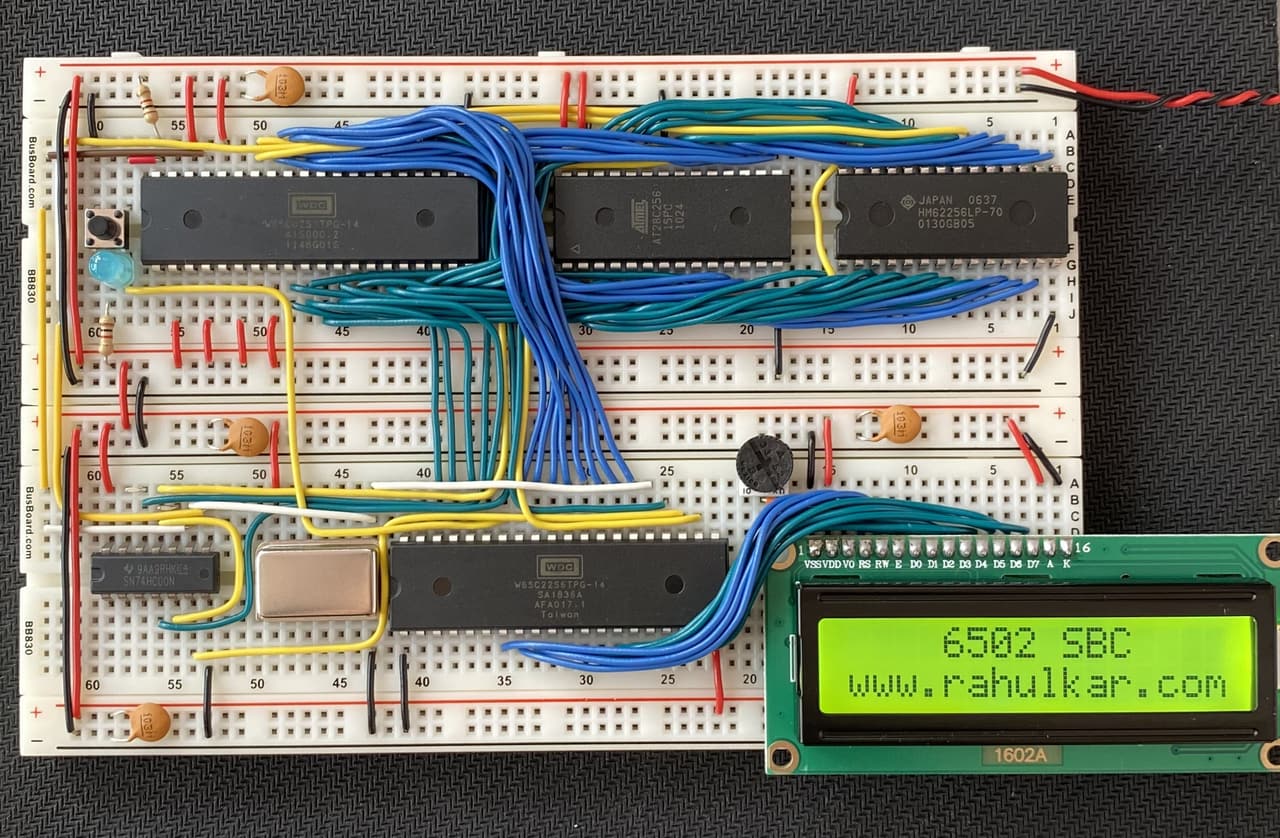
<?xml version="1.0" encoding="utf-8"?><feed xmlns="http://www.w3.org/2005/Atom" xml:lang="en"><generator uri="https://jekyllrb.com/" version="3.10.0">Jekyll</generator><link href="https://www.rahulkar.com/feed.xml" rel="self" type="application/atom+xml" /><link href="https://www.rahulkar.com/" rel="alternate" type="text/html" hreflang="en" /><updated>2026-10-11T03:31:14+00:00</updated><id>https://www.rahulkar.com/feed.xml</id><title type="html">Rahul Kar | Scribbles</title><subtitle>Solution Architect specializing in enterprise software delivery, tooling, proof-of-concepts, agentic AI, cloud, DevOps, and quality engineering. 11+ years of IT industry experience.</subtitle><entry><title type="html">the 6502 on two breadboards</title><link href="https://www.rahulkar.com/scribbles/6502-on-two-breadboards/" rel="alternate" type="text/html" title="the 6502 on two breadboards" /><published>2026-10-11T00:00:00+00:00</published><updated>2026-10-11T00:00:00+00:00</updated><id>https://www.rahulkar.com/scribbles/6502-on-two-breadboards</id><content type="html" xml:base="https://www.rahulkar.com/scribbles/6502-on-two-breadboards/"><![CDATA[<p>A W65C02 running at a crystal’s pace, an EEPROM holding the program, 32K of RAM, one 74HC00 doing the glue logic, and a 16×2 LCD that boots up and says hello. Everything is point-to-point jumper wire, which is exactly the point: nothing sits between you and the bus.</p>

<figure class="polaroid taped scribble__photo">
  <a class="polaroid__open" href="/assets/img/6502-1280.jpg" data-lightbox="scribble-lightbox">
    <picture>
      <source type="image/webp" srcset="/assets/img/6502-640.webp 640w, /assets/img/6502-1280.webp 1280w" sizes="(max-width: 760px) calc(100vw - 48px), 320px" />
      <img src="/assets/img/6502-640.jpg" srcset="/assets/img/6502-640.jpg 640w, /assets/img/6502-1280.jpg 1280w" sizes="(max-width: 760px) calc(100vw - 48px), 320px" width="640" height="419" alt="A 6502 computer built on two breadboards: a W65C02 CPU, EEPROM and RAM chips wired with blue and yellow jumpers, and a green LCD reading 6502 SBC www.rahulkar.com" loading="lazy" decoding="async" />
    </picture>
    <span class="sr-only">(open a larger view)</span>
  </a>
  <figcaption class="polaroid__caption">boots up, says hello</figcaption>
</figure>

<dialog class="lightbox" id="scribble-lightbox" aria-labelledby="scribble-lightbox-caption">
  <button class="lightbox__close" type="button" aria-label="Close">
    <svg class="doodle" aria-hidden="true" focusable="false"><use href="#d-x"></use></svg>
  </button>
  <picture>
    <source type="image/webp" srcset="/assets/img/6502-1280.webp" />
    <img src="/assets/img/6502-1280.jpg" width="1280" height="838" alt="A 6502 computer built on two breadboards: a W65C02 CPU, EEPROM and RAM chips wired with blue and yellow jumpers, and a green LCD reading 6502 SBC www.rahulkar.com" loading="lazy" decoding="async" />
  </picture>
  <p class="lightbox__caption" id="scribble-lightbox-caption">The 6502 breadboard computer, larger view: W65C02 CPU, EEPROM, RAM, a 74HC00, a crystal and a 1602 LCD &mdash; all on breadboards.</p>
</dialog>

<p>It is the best teacher I know for the things cloud consoles hide: address decoding, timing, what a byte actually costs. The “it just works” in my day job started out as a wire like one of these.</p>

<p>The build order matters more than any part. Clock first, then reset, then the address bus with LEDs on it so you can watch the CPU count. Only when the counting is boring do you add memory, and only when memory is boring do you add the LCD. Every platform I have shipped since follows the same rule: make the boring layer trustworthy before building the interesting one on top.</p>]]></content><author><name></name></author><summary type="html"><![CDATA[A W65C02 running at a crystal’s pace, an EEPROM holding the program, 32K of RAM, one 74HC00 doing the glue logic, and a 16×2 LCD that boots up and says hello. Everything is point-to-point jumper wire, which is exactly the point: nothing sits between you and the bus.]]></summary><media:thumbnail xmlns:media="http://search.yahoo.com/mrss/" url="https://www.rahulkar.com/assets/og-sketch.png" /><media:content medium="image" url="https://www.rahulkar.com/assets/og-sketch.png" xmlns:media="http://search.yahoo.com/mrss/" /></entry><entry><title type="html">the bonsai</title><link href="https://www.rahulkar.com/scribbles/the-bonsai/" rel="alternate" type="text/html" title="the bonsai" /><published>2026-10-04T00:00:00+00:00</published><updated>2026-10-04T00:00:00+00:00</updated><id>https://www.rahulkar.com/scribbles/the-bonsai</id><content type="html" xml:base="https://www.rahulkar.com/scribbles/the-bonsai/"><![CDATA[<p>The bonsai on the desk is the slowest feedback loop I own. A cut made today shows up as a branch in two years, and there is no rolling back. It is a good antidote to sprint thinking, and a reminder that the systems worth building are the ones you are still tending long after the launch.</p>

<p>Most of the work is not cutting. It is watering, turning the pot toward the light, and leaving it alone. Platforms are the same: the dramatic decisions are rare, and the quality of the thing comes from the small, boring attention paid between them.</p>]]></content><author><name></name></author><summary type="html"><![CDATA[The bonsai on the desk is the slowest feedback loop I own. A cut made today shows up as a branch in two years, and there is no rolling back. It is a good antidote to sprint thinking, and a reminder that the systems worth building are the ones you are still tending long after the launch.]]></summary><media:thumbnail xmlns:media="http://search.yahoo.com/mrss/" url="https://www.rahulkar.com/assets/og-sketch.png" /><media:content medium="image" url="https://www.rahulkar.com/assets/og-sketch.png" xmlns:media="http://search.yahoo.com/mrss/" /></entry><entry><title type="html">how this notebook is drawn</title><link href="https://www.rahulkar.com/scribbles/how-this-notebook-is-drawn/" rel="alternate" type="text/html" title="how this notebook is drawn" /><published>2026-09-27T00:00:00+00:00</published><updated>2026-09-27T00:00:00+00:00</updated><id>https://www.rahulkar.com/scribbles/how-this-notebook-is-drawn</id><content type="html" xml:base="https://www.rahulkar.com/scribbles/how-this-notebook-is-drawn/"><![CDATA[<p>The page is plain HTML and CSS with a small amount of JavaScript that draws the wobbly frames at runtime using Rough.js. The doodles are drawn once at build time and shipped as static paths. Nothing loads from a CDN, and a strict Content-Security-Policy keeps it that way. The handwriting is Excalifont, the body text is Nunito, and it all builds with Jekyll on GitHub Pages.</p>

<p>The site tests itself: Playwright drives it at phone and desktop widths, axe checks accessibility, and Lighthouse keeps the scores honest on every push. The moon turns it into a chalkboard. If the drawing-in gets in the way, the wave button turns the motion down.</p>

<p>Why bother drawing a portfolio by hand? Because a sketch is honest about being unfinished, and so is every system I work on.</p>]]></content><author><name></name></author><summary type="html"><![CDATA[The page is plain HTML and CSS with a small amount of JavaScript that draws the wobbly frames at runtime using Rough.js. The doodles are drawn once at build time and shipped as static paths. Nothing loads from a CDN, and a strict Content-Security-Policy keeps it that way. The handwriting is Excalifont, the body text is Nunito, and it all builds with Jekyll on GitHub Pages.]]></summary><media:thumbnail xmlns:media="http://search.yahoo.com/mrss/" url="https://www.rahulkar.com/assets/og-sketch.png" /><media:content medium="image" url="https://www.rahulkar.com/assets/og-sketch.png" xmlns:media="http://search.yahoo.com/mrss/" /></entry></feed>